10/26/2026
Heating posts are often enough for a housing company's electric cars
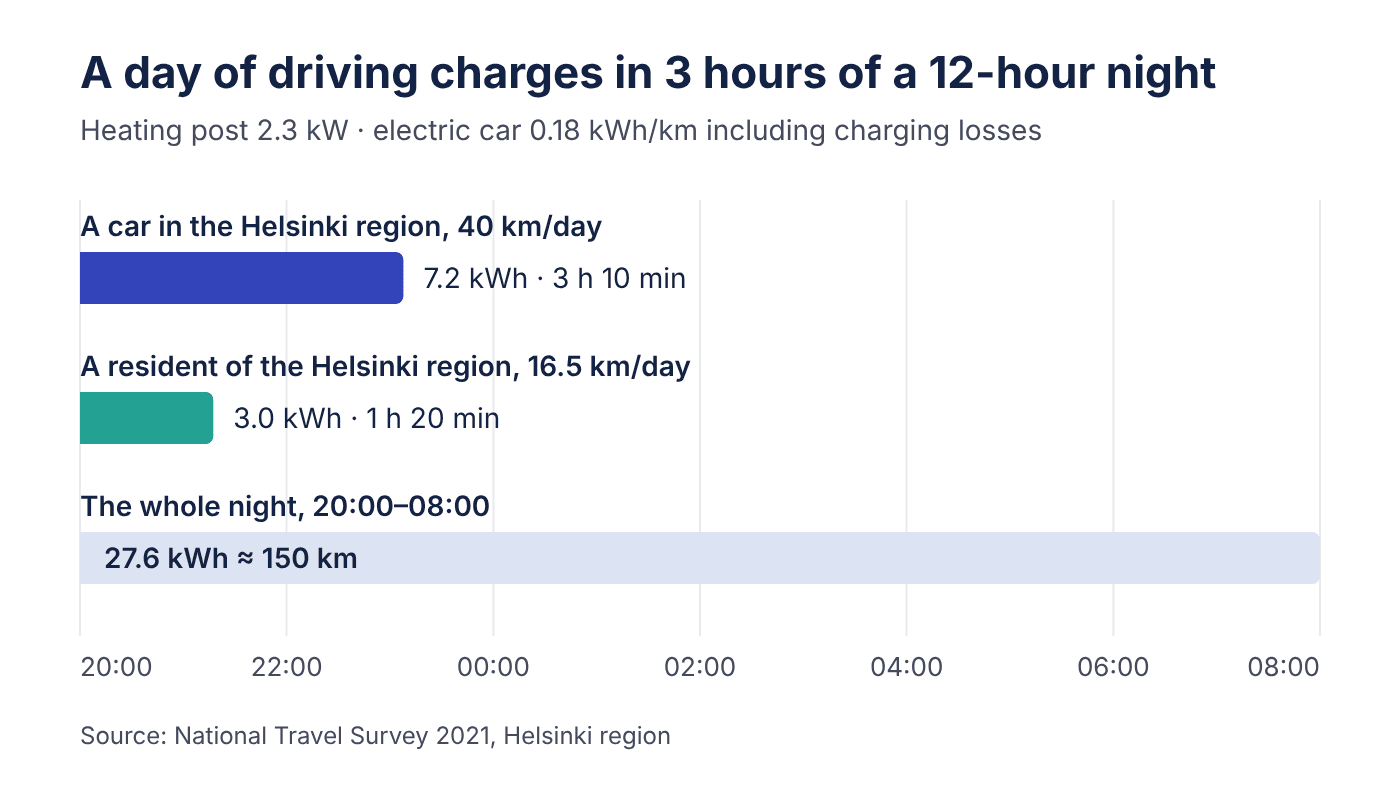
In the Helsinki region a car is driven an average of about 40 km a day, which takes about 7 kWh of electricity. A heating post's 2.3 kW socket charges that in about three hours, and converting a two-space post for charging costs about 750 euros including VAT.
Helsingin Sanomat went through today what a housing company should know about charging electric cars. Its advice was to forget the heating posts and be ready to pay thousands of euros per charging point. Many housing companies can still make do with their heating posts once they work out how much electricity the cars actually need.
How much electricity a car needs
In the Helsinki region, the car of a one-car household is driven an average of 14,596 kilometres a year, or about 40 kilometres a day (National Travel Survey 2021). At about 0.18 kWh per kilometre including charging losses, that is about 7.2 kWh. A heating post converted for charging charges at 10 amperes, about 2.3 kW, so a day's driving charges in about three hours. Across Finland, a passenger car is driven about 14,000 kilometres a year on average, or about 38 kilometres a day, so the figure is almost the same.
Per resident, the Helsinki region drives a car only 16.5 kilometres a day on average, because many people do not drive at all. That charges in about 1 h 20 min.
When the car is plugged in from eight in the evening to eight in the morning, the 12 hours give it about 27.6 kWh, enough for about 150 kilometres. Even if charging were limited to 8 amperes, about 1.8 kW, a day's driving would charge in about four hours.
What the post needs
The article's concern about old posts is justified. A post built for engine block heaters supplies power on a timer in limited spells, and an old socket is not made for hours of continuous load. SESKO's charging recommendation limits charging from an ordinary socket to 8 amperes unless the charging cable's plug senses its temperature. So the post is converted for charging: an electrician inspects the cable, circuit and protective devices that feed the post, the timer is removed, the socket is replaced with one rated for continuous load, and each space gets its own meter. Charging uses the car's own cable or one its manufacturer approves.
In Apex Heat's calculation the conversion costs about 750 euros including VAT per post, which serves two parking spaces. The Type 2 charging infrastructure and charger the article describes cost about 1,900–5,000 euros together for every parking space. For a housing company with 20 parking spaces on ten posts, that is about 7,500 euros against 38,000–100,000 euros.
No operator needed
Charging from heating posts does not need to be outsourced to a charging operator. The property maintenance reads the meters once a year and the housing company bills the charging to whoever holds the space, so there is no operator lock-in.
When slow charging is not enough
Slow charging does not suit someone who drives hundreds of kilometres a day or whose car stands in the yard for only a few hours. Charging from heating posts also has no load management: if 20 cars charge at once, the housing company's peak power grows by 46 kW. So it pays to check whether the current main fuse is enough.
The decision usually passes easily
At about 750 euros for a two-space post, the conversion is a small decision for a general meeting. Owner-occupiers and investors alike usually welcome it, because buyers, tenants and new residents ask for charging more and more often. The number of electric cars is growing fast: there were 63,788 fully electric cars on Finnish roads at the end of June 2023 and 140,798 at the end of June 2025, more than double in two years (Traficom).
Apex Heat calculates three options for a housing company side by side: converting the heating posts, charging readiness and turnkey charging. The calculation shows each one's investment, yearly fees, what the charging adds to the housing company's electricity bill, and whether the current grid connection is enough.