Why can Apex Heat's calculations be trusted?
Apex Heat's calculation is building physics and financial calculation, not averages. Heat losses are calculated from the building's geometry and the building regulations' U-values, energy is priced for every hour of the year against the spot price and the local distribution tariff, and the building's measured consumption corrects the model. Every assumption is shown to the user and can be replaced with their own data. Every stage of the calculation engine is documented, and the documentation is checked against the code on every change. Finland's largest engineering firms use the software in their client work.
9/18/2026
What is the calculation based on?
The calculation is based on three things: the physics of a building's heat losses, the Finnish building regulations, and hourly weather and price data.
Heat losses are calculated per structure: external walls, roof, ground floor, windows, doors, ventilation, air leakage and thermal bridges. The thermal transmittance (U-value) of each structure is taken from the reference level for its construction period in Table 1 of the Ministry of the Environment decree 1048/2017. For example, the reference value of an external wall built before 1976 is 0.81 W/m²K and of one built after 2010 is 0.17 W/m²K; for windows the corresponding values are 2.8 and 1.0 W/m²K.
A structure's age is not assumed directly from the construction year. If a structure is older than its typical renewal interval, it is assumed to have been renewed, but only to the regulation level of one interval ago, never to today's. This way an old building does not get better insulation on paper than a newer one.
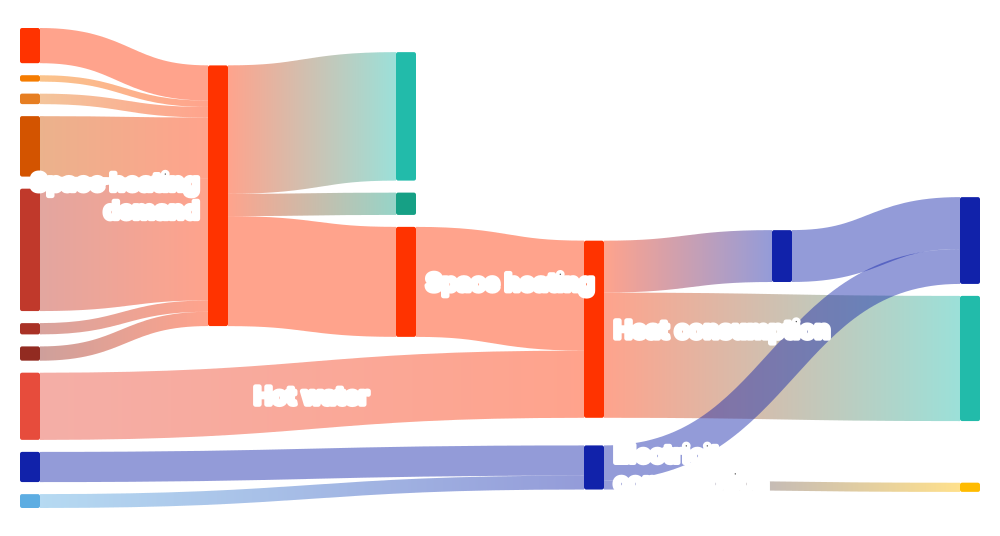
Heating demand, domestic hot water, electricity consumption and heat pump operation are calculated for every hour of the year using weather data for the building's location. Annual figures are sums of those hours.
 Heat losses and heat production are estimated hour by hour from the building's technical data
Where does the input data come from if the user enters nothing?
Building data is fetched from open building and geographic registers. The register provides the building type, construction year, heating method, floor area, number of floors and the lot boundaries, from which the software calculates the envelope areas. This is how the software can produce a first calculation for more than three million Finnish buildings from an address alone.
If the building has a signed energy performance certificate, its data overrides the register: the construction year, building type, heating method, heated floor area and ventilation system are read from the certificate.
The estimate shown to the user is exactly the value the calculation uses if the field is left empty. The estimate and the calculation come from the same code, so a user who accepts every estimate gets exactly the calculation the estimates described. The form shows both the estimate and the value the calculation used side by side.
A value the user enters never changes its own field's estimate, but it does change the estimates of other fields. When the heating method is changed to oil, the estimates for the distribution method and boiler efficiency update, while the heating method's own estimate stays at the register value. This keeps every estimate an independent suggestion rather than an echo of the user's input.
How is measured consumption taken into account?
When the user enters the building's actual heat consumption, the software does not replace the model with the number; it fits the model to it. First it solves which ventilation airflow and air leakage rate would make the model produce the measured consumption, and recalculates the building with those values. Then it scales the heat losses so that the space heating sum lands exactly on the measured figure. The domestic hot water share is not scaled, because it depends on the number of residents, not on the structures.
Measured consumption affects everything calculated after it. Heat pump sizing, hourly energy costs and the savings of each measure are calculated from the fitted consumption, so they describe this particular building. Without measured consumption the same figures are calculated for a building estimated from register data, so the result describes a building typical of its age. The software attributes the difference between the estimate and the measurement primarily to ventilation and air leakage, not to the U-values of the structures.
If the user also states the consumption year, the measured consumption is normalised with heating degree days to the reference year, so that a mild or cold winter does not distort the savings calculation.
How is the energy price calculated?
Electricity is priced for every hour: consumption is multiplied by that hour's spot price, plus the distribution tariff of the building's grid company and the electricity tax. The distribution tariff is selected by grid company and by the building's peak power, so a heat pump's added load shows up in the tariff class. District heating is priced according to the building's district heating company's price list, and oil, gas and wood use historical price series.
VAT is taken into account according to the property's situation, and the same VAT treatment applies to both the investment and the operating costs, so the two are comparable. The user can replace any price with their own value, for example the price of the company's own electricity contract.
How are profitability and the recommendation calculated?
For every solution the software calculates the investment, first-year savings, the heat pump's seasonal coefficient of performance and the net present value. The discount rate for the net present value is the property yield of the building's location or, where none is available, 7 percent. The user can set the discount rate themselves.
The recommendation is not always the largest net present value. Before the comparison the software removes solutions that cannot be built: ground-source heat pumps are dropped if the lot is in an underground zoning area or if the required boreholes do not fit on the lot. The figures for the removed solutions are still calculated and shown, so the user can see what was left out and why.
In a 1950s apartment building in Helsinki, the net present value of the ground-source and air-to-water hybrid was 302,301 euros and that of the air-to-water heat pump 195,188 euros. The software recommended the air-to-water heat pump, because the lot is in an underground zoning area where drilling is not allowed, even though nine boreholes would have fitted on the lot.
How are boreholes sized?
The number of boreholes is not an area division but a placement problem inside the lot polygon. The software places boreholes on a triangular grid within the drillable part of the lot, after subtracting the clearance from the building and from the lot boundary, and searches with around 200 simulations for the arrangement that holds the most boreholes. The space the drilling rig needs is checked separately, because a borehole that cannot be reached cannot be drilled.
Borehole depth and count are chosen by simulating combinations of depth and number, and the ground's heat yield per metre depends on the region and the depth. The result states how many boreholes the building needs, how many fit on the lot and what drilling costs. Read more about borehole sizing.
 Boreholes are placed inside the lot polygon, not divided from its area
Does the software check for incorrect input data?
Yes. The software runs four checks for every building and attaches a warning to the result if a figure is implausible for the Finnish building stock:
- Heat consumption above 300 kWh per heated square metre gives a warning and above 500 kWh an error.
- A heat recovery saving that exceeds the heat consumption is always an error.
- A building under 50 square metres is flagged, because fixed costs and the E-number formula give misleading figures for it.
- A heating cost above 25 cents per kilowatt-hour gives a warning and above 40 cents an error.
A warning does not change the result and does not stop the calculation. It tells the user what to check: the meter reading, the floor area or the price.
How is the energy performance certificate calculated?
The certificate's E-number is calculated with the tables of the Ministry of the Environment decree and the reference weather of the climate zone, not with the actual weather at the building's location. The same calculation runs for every measure scenario, so the energy class before and after an investment is comparable.
The finished certificate is converted to the file format of the ARA energy certificate register and submitted to the register from the software. If the certificate lacks data the register requires, the submission stops with an error instead of sending an incomplete certificate.
Is the calculation documented?
Yes. Every stage of the calculation engine has a document describing what the stage calculates, from which inputs, under which assumptions, and what its known limitations are. The documentation references the calculation code's functions directly, and an automatic check on every code change verifies that the references and the stated figures match the code. The documentation is also available to Apex Heat's customers through an AI assistant.
The calculation methods build on CEO Jussi Vimpari's research in the real estate economics research group at Aalto University. Our customers' engineers have compared the calculations with realised heat pump and energy efficiency projects. Read how the profitability of an investment is calculated.
What does the calculation not know?
The calculation knows nothing about the building beyond what the registers, the energy performance certificate and the user tell it. The register's construction year can be wrong, a structure may have been renewed without it being recorded anywhere, and the U-value reference level is an assumption for the period, not a measurement. Without measured consumption the result is a modelled estimate whose purpose is to give the right order of magnitude and the right order of priority between measures, not a kilowatt-hour-exact figure.
That is why the software is built for a consultant who knows the building. The consultant enters the measured consumption, the renovation years and the known structures, and the calculation does the rest the same way every time. In a housing company in Lauttasaari, Helsinki, accounting for a window renovation that had just been completed reduced the cost estimate of a ground-source heat pump project by 100,000 euros. Read the example.
Who uses Apex Heat?
Users include A-Insinöörit, AFRY, FCG, Retta, Sustera and Sweco. For Espoon Asunnot a stock of more than 1,200 buildings was calculated, and for Balder Finland part of its commercial properties. In 2024 the Finnish Real Estate Management Federation selected Apex Heat's energy audit among the most promising services for housing companies. See the customer references.
Frequently asked questions about the calculation
Without measured consumption the result is a modelled estimate that gives the right order of magnitude and the right order of priority between measures. When the user enters the building's measured consumption, the model is fitted to it and the savings calculation is based on actual consumption.
Yes. Electricity is priced for every hour with the actual spot price, plus the distribution tariff of the building's grid company and the electricity tax. The user can replace the price with their own contract price.
Yes. Every assumption is shown in the form as an estimate, and the user can replace it with their own value, for example a U-value, the ventilation, the heat pump sizing, an investment price or the discount rate. A company can set account-level defaults for, among other things, financial parameters and the solutions to calculate.
The certificate is calculated with the Ministry of the Environment decree's tables and reference weather, and it is submitted to the ARA register from the software. The certificate is prepared and signed by a qualified certificate author.
The software checks heat consumption per square metre, heating cost per kilowatt-hour, the heat recovery saving and the building's size, and attaches a warning to the result if a figure is implausible for the Finnish building stock. A warning does not change the result.
Read more


How easy is Apex Heat App to use?
What data is needed, how estimates work and what the software produces.