4/17/2026
Real electricity and heat consumption data as the basis for the calculation
Heat and electricity consumption time series can be uploaded to a project as a CSV or XLSX file. Apex Heat App's algorithm is built on an hourly calculation, so the building's own measured hourly consumption sharpens heat pump sizing and the investment case.
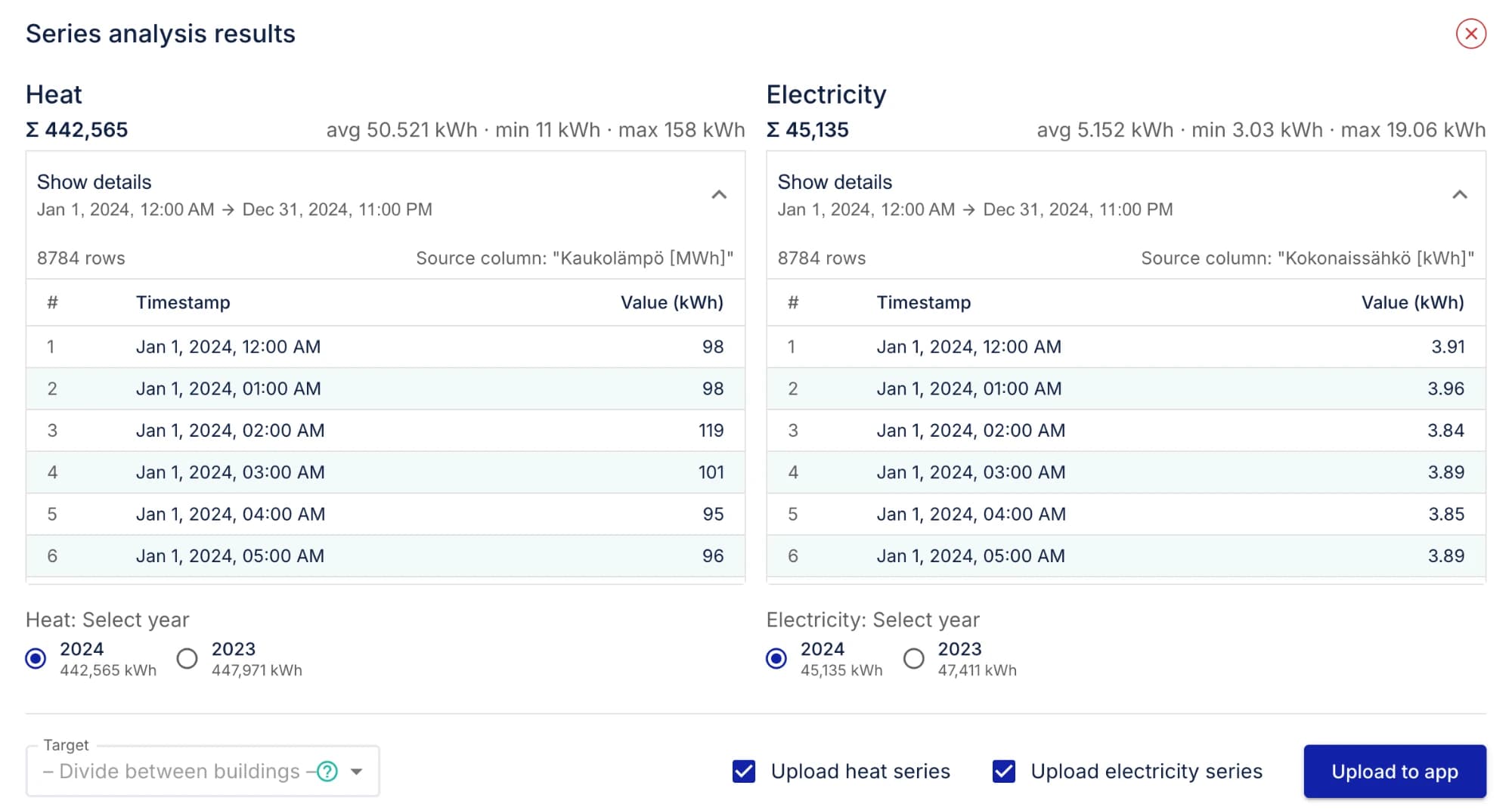
An energy consultant's input data usually already exists as a file: an hourly report from the district heating utility, an electricity consumption extract, an export from a building management system. Until now, one number had to be picked out by hand, annual consumption, and the calculation spread it across the hours using a typical load profile. Now the file can be uploaded as it is, and the calculation uses the building's own measured hourly series.
Apex Heat App's algorithm is built on an hourly calculation: space heating demand, domestic hot water, electricity consumption and heat pump operation are each resolved for every hour of the year, and the annual figures are the sums of those hours. A measured hourly series therefore lands exactly at the resolution the calculation works at anyway: what was actually metered at the building replaces an assumed load profile.
You can still run investment and measure calculations by editing annual consumption, and in many cases that is accurate enough to produce the project plan.
How it works
In the project's Energy consumption data section you upload a CSV or XLSX file. The rest happens automatically:
- Separator, character encoding, header rows and the timestamp column are detected from the file itself. No renaming columns, no cleaning up the data first.
- Heat and electricity series are identified and handled separately.
- The import reads hourly or 15-minute data: 15-minute data is aggregated to hourly, and daylight saving time shifts are normalised.
- Monthly consumption data can be imported as well. It is read as an annual total, which the calculation spreads across the hours from weather data, so it does not stand in for measured hourly variation.
- Short measurement gaps are filled. If there are too many gaps, the series is rejected rather than patched with guesswork.
- If the file covers several years, you choose which year to use, separately for heat and electricity.
The imported series is stored in the project as a consumption profile, either for a single building or for the whole property. A property-level series is divided between buildings in proportion to each building's modelled consumption, separately for heat and for electricity. While a profile is in use, the matching annual consumption fields are locked, so that a profile and a hand-entered annual figure never both reach the calculation.
Detection covers the common Finnish report formats. If your file does not go through, send it to us. We will add support and let you know when it is ready.
Why hourly data matters
Heat pump sizing and profitability are not always settled by annual consumption alone. A single building's peak hours and the variation in its consumption can be several times its average hour, and that is what decides how the pump should be sized: what the peak load is, how large the summer domestic hot water load is, and what share of consumption falls outside what the pump covers. A measured hourly series shows these directly. An assumed profile shows them only to the extent that the assumption happens to hold.
When the input is the building's own metered data, the savings and payback figures in the investment proposal become more precise. The calculation fits the model to the measured consumption rather than replacing it with the number. Read in more detail how measured consumption is taken into account.