11/12/2026
Correcting ventilation running times saves an example office about €25,000 a year with no investment
We calculated what corrected running times and EC fans save in an office building with three ventilation units. The running times brought about €25,000 a year with no investment. New fans pay for themselves in about a year on the unit that gets demand control with them, and in about 11 years on the others.
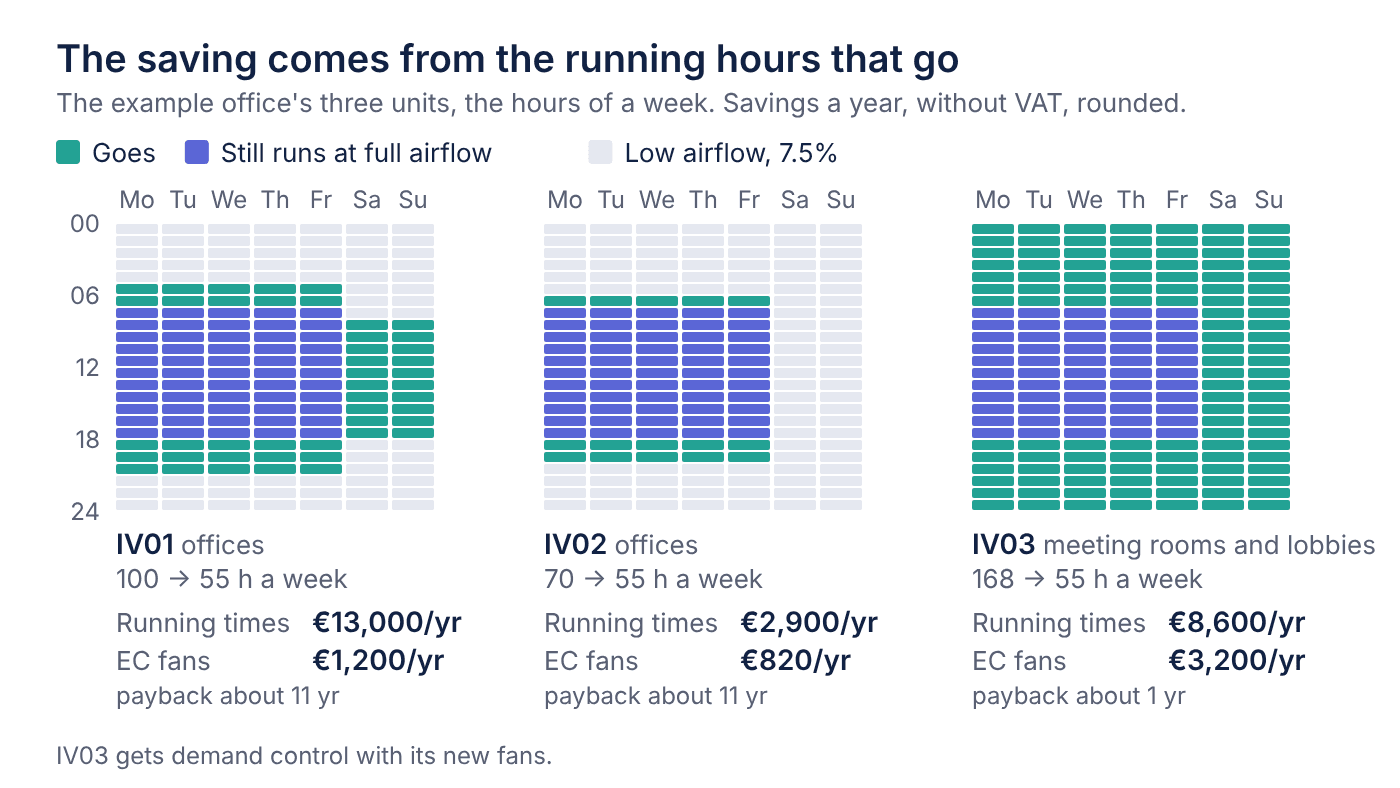
An office building in Helsinki, built in 1991, has three ventilation units. One runs at full airflow 100 hours a week, another 70 hours and the third around the clock. When all three are moved to run at full airflow only on weekdays from 7 to 18, the calculation shows a saving of about €25,000 a year: about 190 MWh of district heat and 60 MWh of electricity. The change needs no investment, because it is made in the units' existing control settings.
This is an example calculation. The building exists, a district-heated office of about 5,800 square metres, but the units' data and running times are our assumptions. We calculated the case with the ventilation measures of Apex Heat App, which were released in November.
What went into the calculation
The units are supply and exhaust units from 1991. They have fixed-speed fans and a plate heat exchanger, and the fans' specific fan power (SFP) is 2.5 kW/(m³/s).
- IV01 serves 3,000 square metres of office space and runs on weekdays from 5 to 21 and at weekends from 8 to 18.
- IV02 serves 2,000 square metres of office space and runs on weekdays from 6 to 20.
- IV03 serves 750 square metres of meeting rooms and lobbies and runs around the clock every day. The occupancy of its spaces during running time is 40%.
Outside the running time the units run at a low airflow, 7.5% of the full one, which is 0.15 litres a second per square metre. The new running time given to all units was weekdays from 7 to 18, and the new fans' target SFP 1.5.
No airflows were entered, so the app estimated them: 6, 4 and 1.5 m³/s. The 50% temperature ratio of the heat recovery and the building's consumption, about 720 MWh of heat and 400 MWh of electricity a year, are estimates as well. Prices and savings are without VAT.
Corrected running times save just over a quarter of the purchased heat
Ventilation schedule optimization saves about 190 MWh of heat and 60 MWh of electricity a year. That is just over a quarter of the building's purchased heat and about 15% of its electricity, about €25,000 a year in all.
IV01 saves about €13,000 a year, IV03 about €8,600 and IV02 about €2,900. IV03's airflow is only a quarter of IV01's, but running around the clock it brings about two thirds of IV01's saving. IV02 already runs on weekdays only, and its running time falls from 70 hours a week to 55, so it has the least to correct.
EC fans pay for themselves in a year or in 11 years, depending on the unit
An EC fan (electronically commutated) is a fan whose motor is driven by its own electronics. Its speed can be adjusted steplessly, and at the same airflow it uses less electricity than an old fixed-speed fan. In this calculation the specific fan power falls from 2.5 to 1.5 kW/(m³/s).
Across the building, replacing the fans with EC fans saves about 52 MWh of electricity and 4.4 MWh of heat a year, about €5,200 in all. The replacement costs about €26,000, so it pays for itself in about five years. Unit by unit the difference is large:
- IV01 saves about €1,200 a year and IV02 about €820, for investments of about €13,000 and €9,000. The payback time of each is about 11 years, while the fans' lifetime is assumed to be 15 years.
- IV03 saves about €3,200 a year, and its investment of about €3,300 pays for itself in about a year.
IV03 is the only unit that gets demand control with its new fans. The control runs the unit according to the 40% occupancy of its spaces, so there is less air to heat and the fans turn more slowly. For a fixed-speed fan the control cannot be calculated as a separate retrofit, because such a fan cannot reduce its airflow.
Lowering the supply-air temperature saved nothing
We also tried lowering the supply-air set-point from 21 to 18 degrees, but it produced no row in the results. The app gives the reason: the building has room thermostats, so the space heating replaces the heat the supply-air heating coil no longer gives, and the coil's heat is billed with the same heating. The result can be different if there is no room-level control or the supply air is heated with a different energy than the rooms.
Why the savings are not calculated separately and added up
The measures are calculated as a chain: the EC fans' saving is calculated for the hours the units are left with after the running times are corrected. The sum of the rows is therefore always the measures' joint saving, here about €30,000 a year.
For heat, the calculation takes into account two things that a rough estimate easily leaves out. Heat from people, equipment and the sun already covers some of the hours, and reducing ventilation saves no heat then. A supply fan's electricity, in turn, ends up as heat in the supply air, so when the fan runs less, the heating produces that heat in its place.
What implemented projects have reported
The City of Kokkola optimised the building automation of the Isokylä multipurpose building: the running times of the ventilation units were limited to the hours they are needed, indoor temperatures were lowered and heating curves were adjusted. According to the city, electricity consumption fell by about 230 MWh and heat consumption by about 550 MWh a year, which saves about €61,500 a year. The figures cover the whole package of measures, not the running times alone.
In Aallonharja, a 20,000-square-metre office property in Otaniemi, Espoo, a ventilation control was installed in the restaurant kitchens in 2023 that boosts the ventilation according to the activity in the kitchen. According to the supplier, it saves six per cent of the property's heating energy, about €11,000 a year, and the investment of about €17,000 pays for itself in 1.5 years. The description was written by the system's supplier, and it does not say how the saving was measured.
Both descriptions are in the Kestävyysloikka service maintained by the Finnish Environment Institute. The pages are in Finnish.
What the figures rest on
The saving follows directly from the assumed running times: if the units already run only when the spaces are in use, there is nothing to save. The current schedules therefore have to be read from the building automation, and the new running times have to match the actual use of the spaces, since too short a running time can weaken the indoor air. The consumption is the app's estimate here, too, and measured consumption makes the savings more accurate.
For a building that needs continuous ventilation, the app does not calculate shorter running times. These are buildings completed in the previous calendar year or later, buildings with moisture damage, and for example hospitals, daycare centres and swimming halls.
The running-time change costs €0 in the calculation, because nothing is installed in it, and work a contractor charges for can be entered as the measure's cost. The price of the EC fans is the app's estimate from the airflow, and a quoted price replaces it.
How to calculate the same for your own building
- Select the measures. They are checkboxes in the Investments and measures section, under the headings Ventilation controls and adjustment and Ventilation equipment renewal.
- Enter the units. The Enter the units button creates rows for the units. Enter the floor area served, the SFP and the current and new operating time for each, and set Building services measures are analysed to Each ventilation unit separately.
- Read the results unit by unit. You see each unit's saving as heat, electricity, carbon dioxide and euros, and the reason for the measures that were not calculated.
Read more about how our calculation works